The AI Asset Foundation
How to build for exponential growth as AI grows in capacity, capability and adoption
A vision for AI
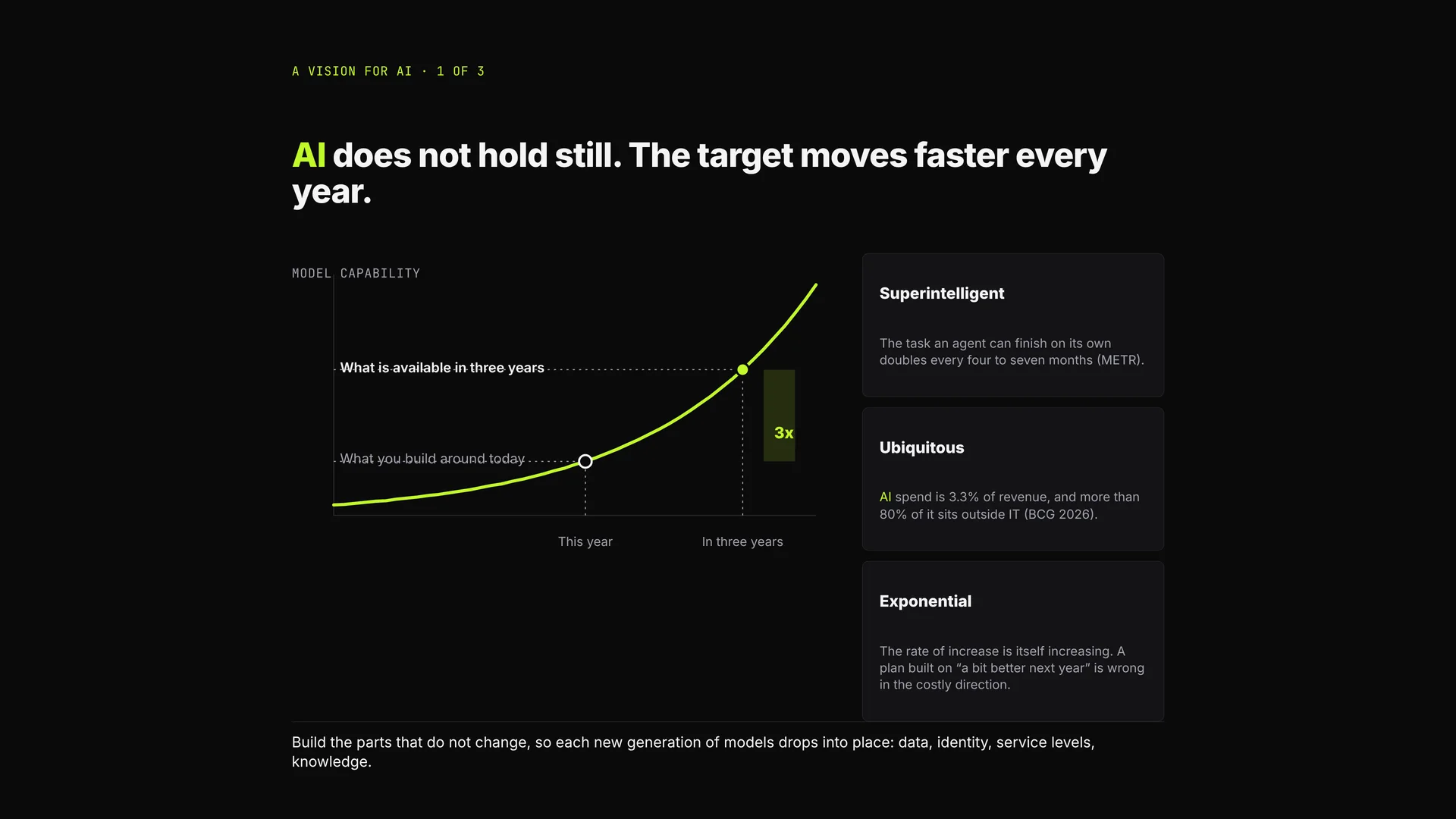
AI is the most transformational technology in history, with obvious potential to reinvent business, the economy, careers and what it means to be human. What is less obvious is the shape of the change. Steam, electricity and the computer each arrived once and then improved slowly enough that a company could adopt the technology, absorb it and move on. AI does not hold still. Model capability is growing on an exponential curve, accelerating at an accelerating rate, which means the AI a company builds around this year will be a small fraction of what is available in three. The challenge of investing in AI is that the target moves, and moves faster every year.
The diagrams throughout are drawn from a companion slide deck you can click through.
That changes what a vision for AI has to do. A vision that pictures the implementation of known technologies, a plateau the company reaches and then occupies like a permanent structure, will be obsolete before the structure is built. The vision has to describe how the company responds to technology that keeps changing: how fast it adopts, how quickly it rebuilds the way its work is delivered, and how it keeps pace with growth that accelerates.
The most important investment a company can make is an investment into its capacity for change.
AI will be superintelligent, ubiquitous and exponentially growing, and a company’s AI strategy has to be built for that AI rather than for the AI of this year.
Superintelligent, in the sense that matters to a business. For a growing share of knowledge work the best model already outperforms the best employee, and the share widens every year. METR measures the length of task a frontier model can finish on its own and finds it doubling roughly every seven months, with the most recent trend closer to four. A task that needs a skilled person for a full day today will be routine for an agent within two years.
Ubiquitous. AI is already in the phone, the browser, the office suite and the customer’s hands. Corporate AI spend has reached 3.3% of revenue, and more than 80% of it sits outside the IT budget [2]. The question for a mid-sized company is no longer whether AI arrives but whether the money being spent on it builds assets or buys subscriptions.
Exponentially growing. Exponential means the rate of increase is itself increasing. A plan that assumes next year’s AI will be somewhat better than this year’s is wrong in the direction that costs the most. The parts worth building are the ones that do not change (the data, the identity, the service levels, the register), so that each new generation of models drops into place.
That kind of AI changes what everyone outside the company expects of it. Customers will arrive with agents of their own and expect machine-readable answers; the standard shifts from “answered within a day” to “resolved while I was asking,” and what delighted a customer last year is the baseline this year.
Inside the company, capabilities are stable and delivery is not. Every company still has to price its product, win customers, serve them, manage its assets and close the books. What changes is who delivers each capability (people, agents, or a mix), how fast, at what cost, and what the people depending on it can expect. An analysis that took three weeks takes an hour, and the hour becomes the new floor.
The gap
Most companies are struggling with AI on both horizons at once. They cannot find the short-term gains in their earnings, and they cannot say what their longer-term investments in the technology are building.
Nearly nine in ten companies now use AI regularly, and 80% of people say it has made them more productive, yet only 37% of companies can attribute any EBIT impact to it [1]. A majority of CEOs say they have seen no significant financial benefit to date [3]. Only a quarter of AI initiatives delivered the return expected of them [4], and the most-quoted study of the last two years found 95% of organizations getting zero return on generative AI [5]. Nearly half of companies are generating some value [2], but the value is concentrated in a small group (the 7.5% BCG calls future-built, the 6% McKinsey calls high performers) that redesigned the work rather than adding tools to it.
The gap is not a technology problem, and it is not a talent problem. The tools work, and employees are ahead of their leaders in using them. The gap is strategy and vision. Most companies bought AI without deciding what kind of company they were trying to become, so adoption produced faster individuals and an unchanged business.
Two failure modes
As companies try to adapt to AI, there are two common strategic failure modes, and one path in the middle that leads to stable and compounding returns.
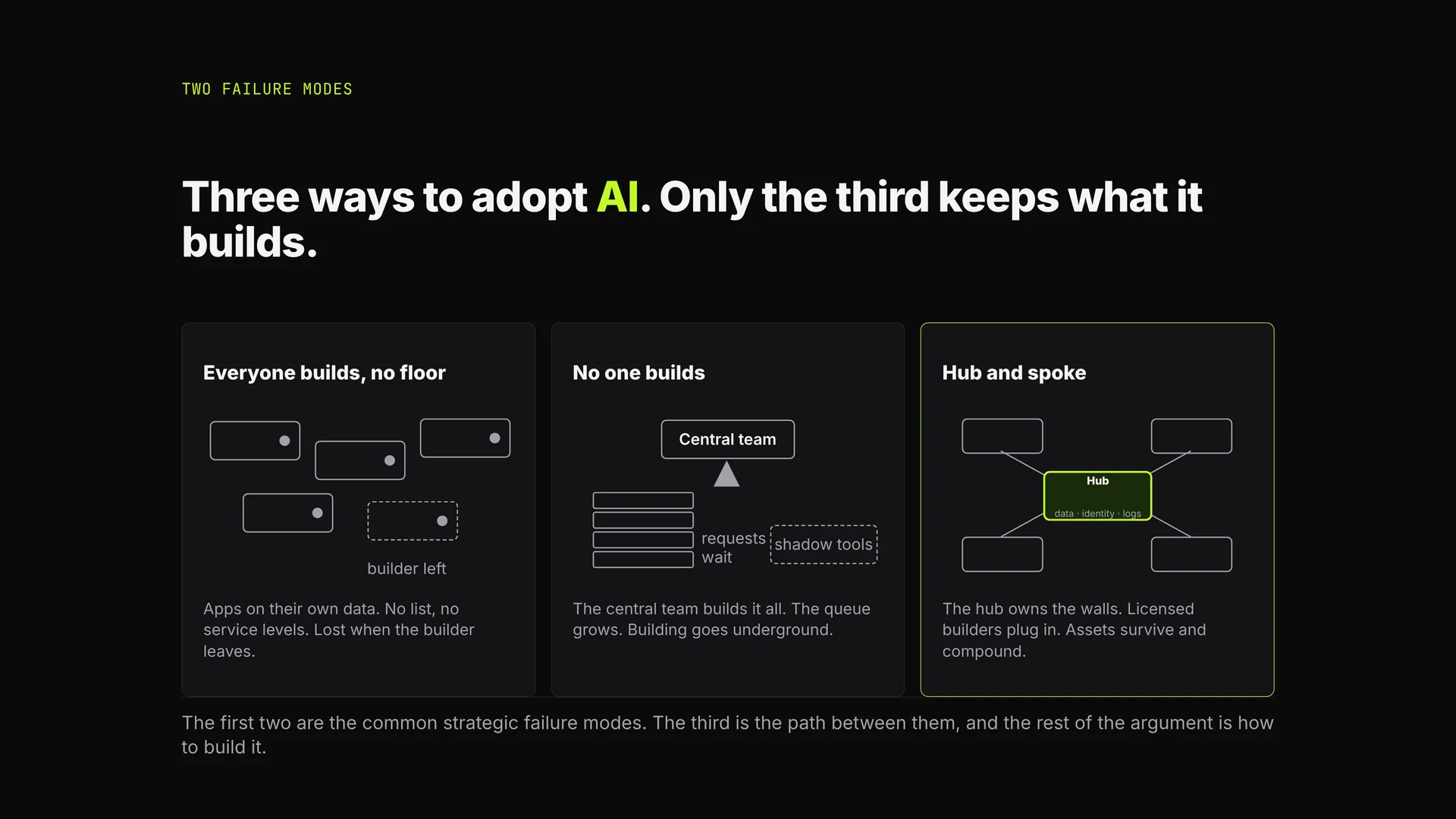
The first company’s applications hold their own data and die with their builders; the second company’s queue pushes building underground; the third company’s spokes plug into a hub that keeps the data, the identity and the record.
The company that lets everyone build, with nothing underneath. Experimentation is allowed, even encouraged, but nothing has been built for it to stand on. The people who understand the work build dashboards, apps, workflows and agents that create real value, each on its own tools, its own copies of the data and its own understanding of what is allowed. No one keeps a list. There are no standard operating procedures, no service levels, no documentation, and no review of what each application may read or do. The data these applications produce lives only inside them, so it can feed nothing else, and the knowledge of how they work lives only in the builder’s head.
The failures are predictable: duplicated spend, applications nobody can maintain, a customer record copied somewhere it should not be, and sooner or later the departure of the one person who understood the most important one. Workers at nine in ten companies already use personal AI tools for work [5], so most companies are this company whether they have decided to be or not.
A personal story. Years ago I worked for a Microsoft Office training company, and a trucking company called us in to look at an Excel workbook. Somewhere along the way they had hired a gifted analyst (the staff called him the mad scientist) who built a workbook that did the work of software and ran a large part of the operation. Then he left, without documentation. Nobody could follow the logic, so nobody could change it, and all the data the business relied on was locked inside the workbook, where it could not feed a dashboard or a report. The company threw it away and started over. Every undocumented AI application is that workbook, waiting for its builder to leave.
The company that lets no one build. Some firms ban employees from building with AI and route everything through IT. The ban is safe in the way an unplugged building is safe. Employees are roughly three times more ready to use AI than their leaders assume, the building happens anyway in the shadows, and more than 80% of the spend is already outside IT. A central team is too slow, too far from the work, and too small to keep up with a capability curve that doubles every few months.
The right approach is both open and closed, stable and flexible
The third company decides what must be central, managed and boring, and what can be creative and fast at the edge. Data access, identity, logging, a standard way to build and the rules for what plugs in where go into a hub, the way a utility puts the wires in the walls, and employees are licensed to build on it. An analyst who finds a report running on stale data builds the fix on the hub: it reads the company’s data instead of copying it, carries a service level that matches its blast radius, logs what it does, and leaves its documentation behind. When she is promoted, the fix stays. This is the post-AI company: capabilities delivered by a changing mix of people and agents, service levels that rise every year, and AI assets that compound. Five things are true of it:
- An agent can reach the company’s core data without asking a person.
- Every AI asset has an owner, a service level and a score.
- The company gets better at building because it built: each project leaves behind knowledge the next one starts from.
- Decision rights for agents are written down, and widen on evidence.
- It can show an investor the register.
Building the third company comes down to four things: what goes in the hub, how employees innovate on it, how the organization is redesigned around capabilities delivered by people and agents, and how to measure whether the assets are compounding.
The hub and the spokes
Think about how electricity reaches a house. The utility is a deliberately boring company that delivers the same product every day without fail. The lines, the panel and the outlets in the walls are governed by codes, inspections and standards. Because the walls are boring, anyone can plug in a new toaster, a lamp or a dishwasher, and if the toaster fails it fails alone. The grid stays up.
AI in a company works the same way. The hub is the utility. It delivers data access, identity, logging, a standard way to build and publish, and the rules for what plugs in where. The spokes are the endpoints: a revenue dashboard, a contract summarizer, a workflow that drafts the monthly report, an agent that watches for a missed budget. Employees who are not developers build the spokes, and that is the point. The people who know the work are the ones who should be shaping it.
A utility is working when using it requires no approval.
The test of a hub is that simple. If a builder has to ask someone for a data extract, a login or a server, the wall is not finished.
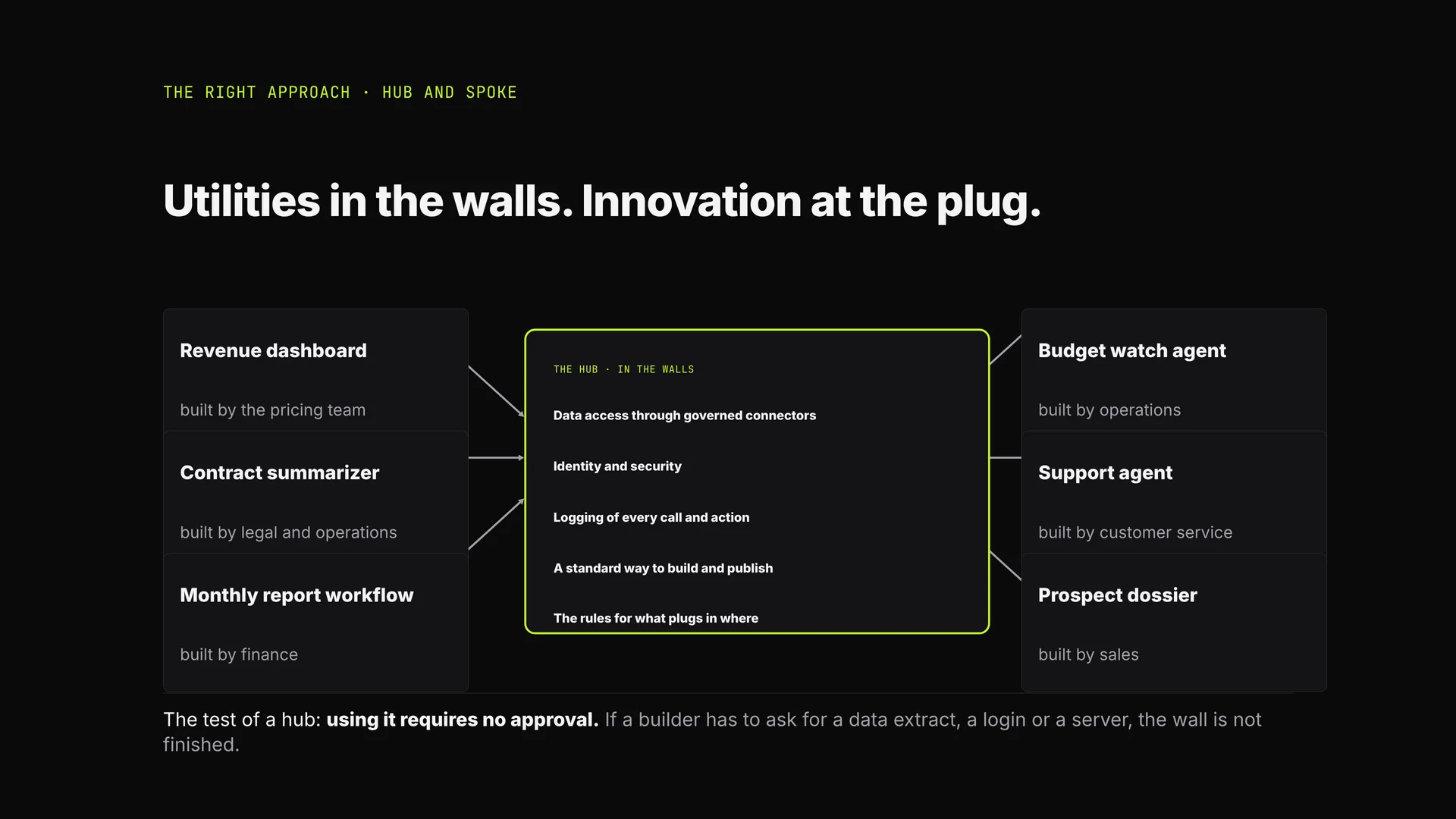
Each spoke reads through the hub’s connectors and writes back to a system of record, so nothing is trapped inside it, and if a spoke fails it fails alone.
What goes in the hub
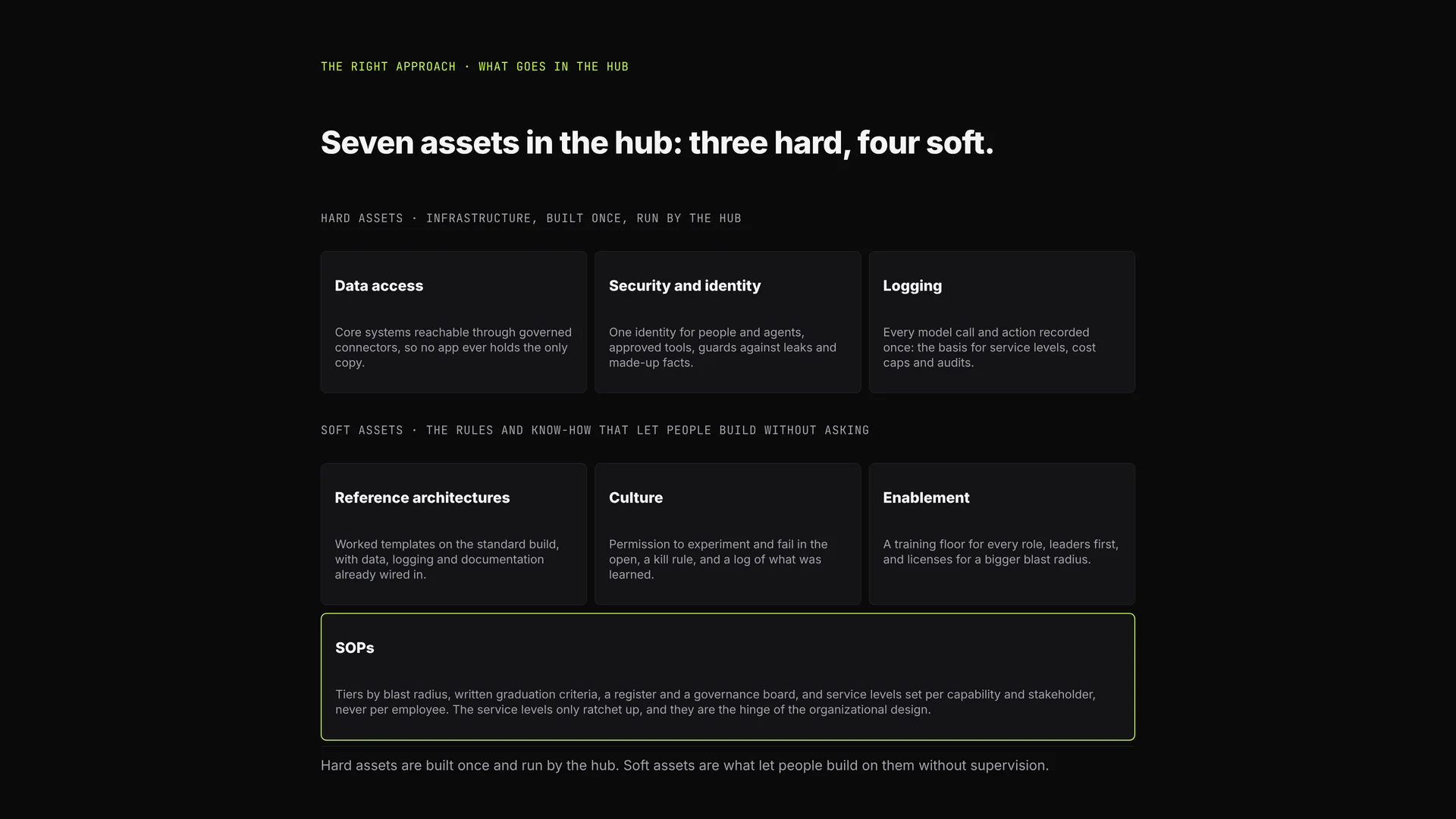
Hard assets are built once and run by the hub. Soft assets are the rules, habits and know-how that let people build on them without supervision.
Employee-driven innovation
Innovation creates the biggest gains when the right employee thinks of the right thing. A pricing analyst who notices that quotes are being built on stale competitor data, and builds the fix, is worth more than a central team that never sees the problem. The hub exists so that this person can build the fix without creating the next trucking workbook. Four conditions make that true, and all four come from the hub, not from the builder.
1. It does not trap the data
Everything an edge application reads comes through the hub’s connectors, and everything it produces goes back to a system of record or the warehouse. The application is a view and a process, never the home of the data. When the workbook died, the data died with it; when a spoke built on the hub is retired, its data is already where it belongs. The practical rule is that no edge application may hold the only copy of anything.
2. It can be maintained to a service level that matches its blast area
What does it mean for an application to be in production? It means support standards that match its criticality and its security needs, set to balance what the business expects against what IT can sustain. Service levels are set by capability and by stakeholder (employees, agents, customers, partners, investors), never by employee. The service level on the monthly forecast belongs to the capability, whoever or whatever delivers it this quarter. This is the hinge on which the organizational design turns.
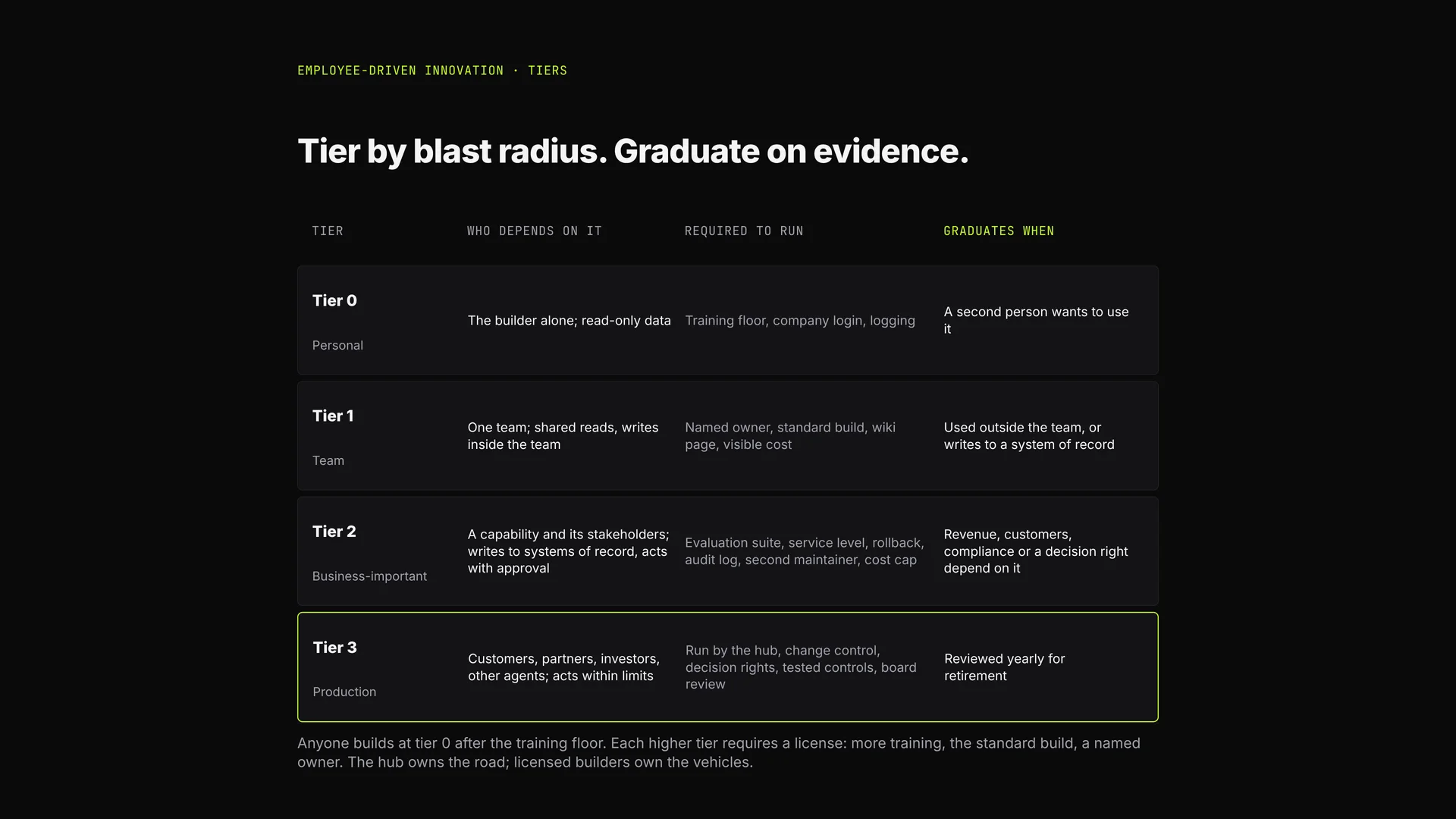
Anyone may build at tier 0 after the training floor. Each higher tier requires a license: more training, the standard build, a named owner, and at tier 2 an evaluation suite and a service level. The hub owns the road; licensed builders own the vehicles.
Graduation is a product the hub runs, not a committee. The criteria are evidence, not opinion, and the hub measures how long graduation takes so that the road gets faster. Microsoft runs its Power Platform estate on the same idea (productivity, important and critical tiers), and ZF Group licenses “Citizen Pros” to build for the plant floor. The pattern is proven; AI raises the stakes.
Surviving the builder’s departure is a tier 2 question, asked at graduation rather than at the exit interview. Who runs it tomorrow (a second maintainer, a runbook, the standard build so the hub can redeploy it)? How is it changed safely (version control, the evaluation suite run before every change, rollback that has been tested once)? How do we know it still works (the evaluation score tracked over time, every call logged, an alarm on the service level)? When does it stop (a retirement date in the register)? The most important move is that the standard build generates the wiki page, the runbook and the data map as a byproduct of building.
Documentation that depends on the builder’s goodwill is not documentation.
3. It is self-improving
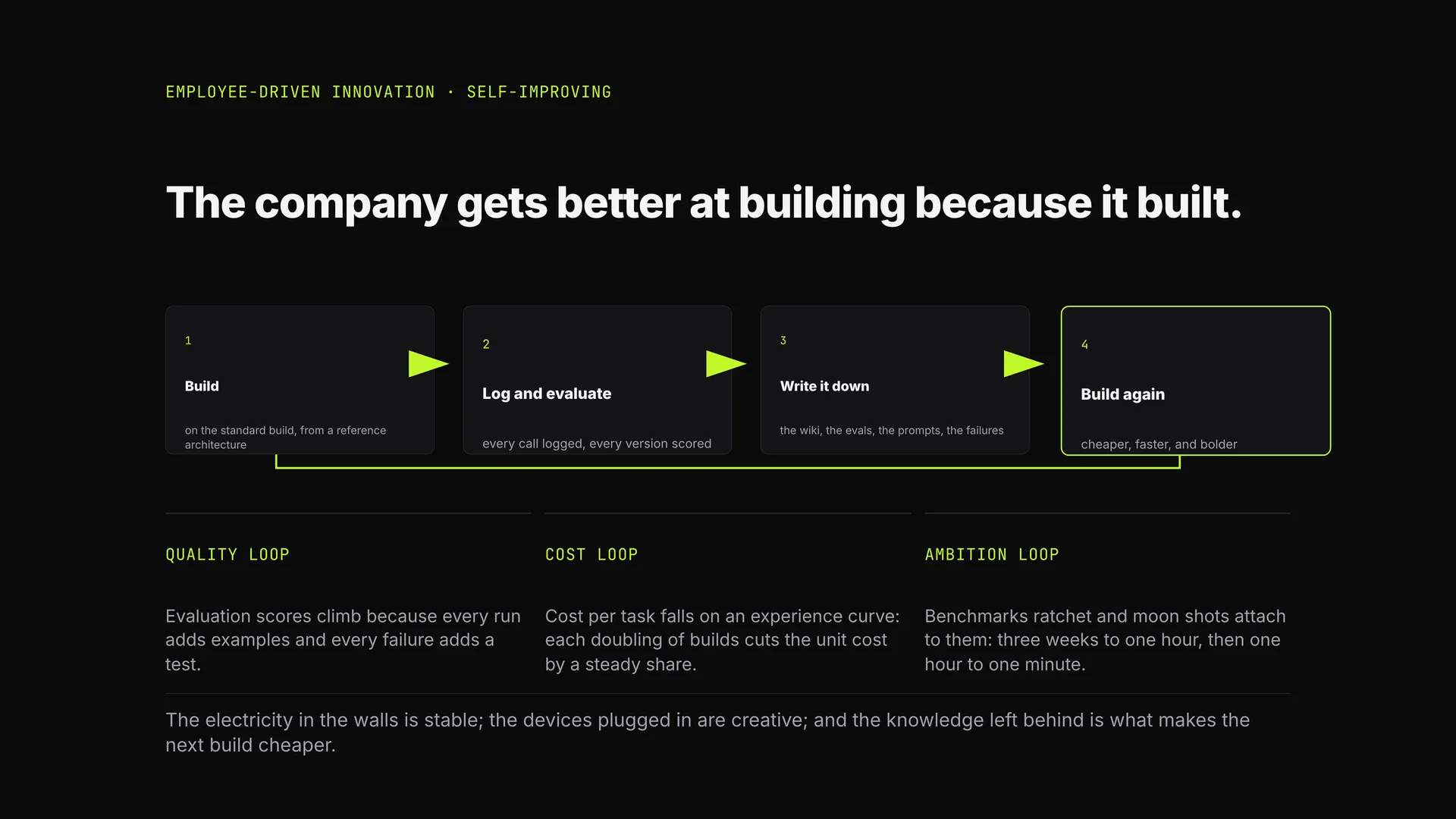
An application built on the hub gets better with use because the hub captures what use teaches. Every production asset carries an evaluation suite, a set of real cases with known good answers, and every change is scored against it before it ships. Every run is logged, so failures become new test cases. Every builder leaves a page in the wiki, so the next builder starts from a reference architecture that already works and a record of what did not. This is the recursive side of the grid: the electricity in the walls is stable, the devices plugged in are creative, and the company gets smarter at building things because it built things. Three loops run at once. Quality climbs as evaluation scores rise. Cost per task falls on an experience curve as builds accumulate. Ambition rises as benchmarks ratchet and moon shots get attached to them: three weeks to one hour, then one hour to one minute.
4. It is secure and compliant
Security and compliance are inherited, not reinvented. A spoke on the standard build logs in with company identity, reads through governed connectors, writes through audited paths and leaves a trail. The builder never handles a credential, never copies a customer record to a laptop, and never decides alone what the application is allowed to do. Compliance is a property of the walls. A builder who had to think about it has been handed the wrong tools.
Rethinking how the business delivers its capabilities
Edge innovation produces point solutions. Rewiring the house is the other mode, and it needs a different unit of analysis than the department or the job.
Capabilities will not change with AI. Execution and expectations will.
So the business is modeled as a set of capabilities, each delivered by some mix of people and agents, each with a service level that only moves up. The departments, roles and incentives are then rebuilt around that model, rather than the model being bent to fit the org chart.
Capabilities, not departments
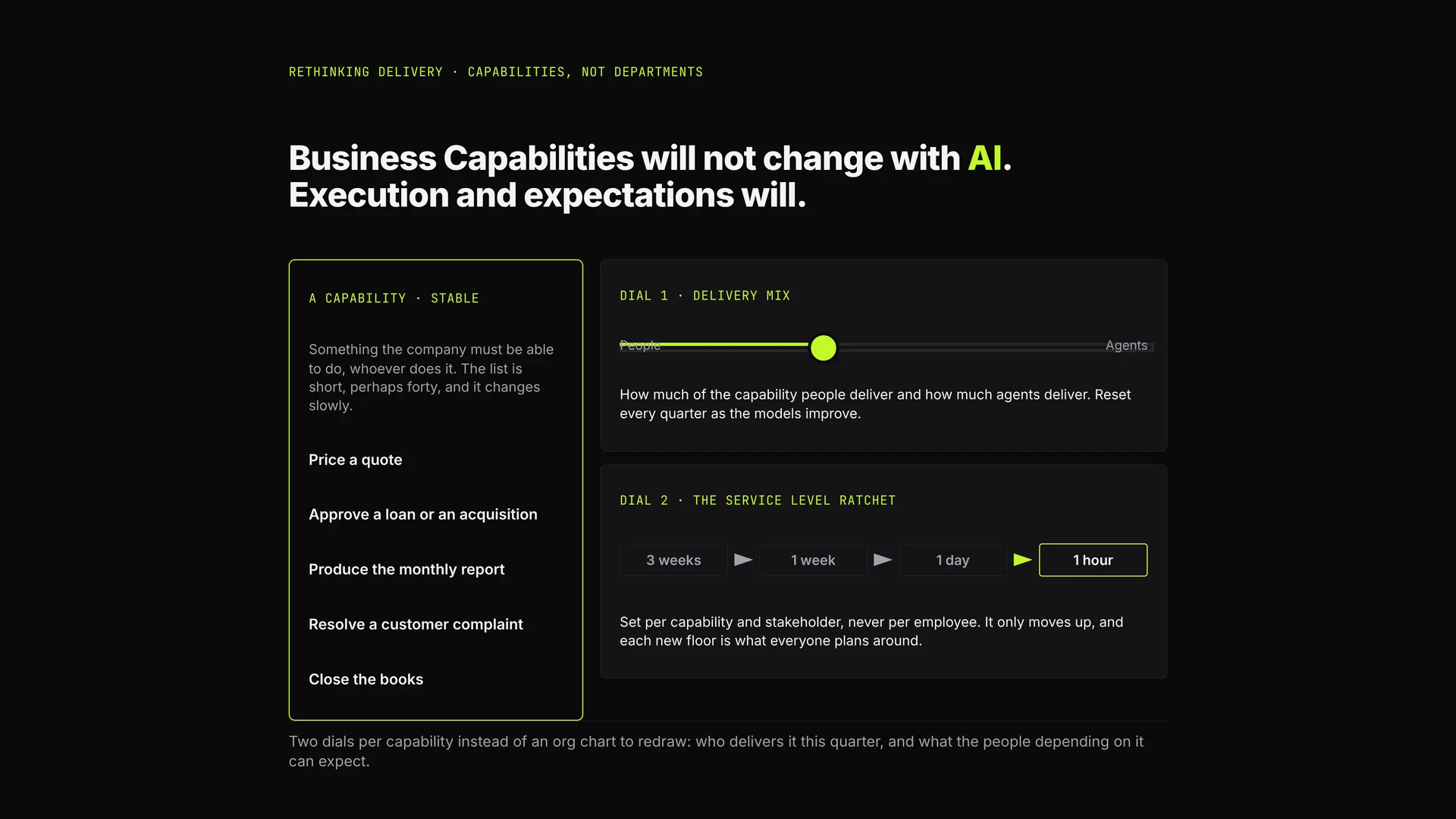
A capability is something the company must be able to do, whoever does it: price a quote, approve a loan or an acquisition, produce the monthly report, resolve a customer complaint, close the books. The list is short (a mid-sized company has perhaps forty) and it changes slowly. Modeling the company this way does two things. It gives every piece of edge innovation a home, so that a builder thinks about what the capability is trying to accomplish and not only about the point solution in front of them. And it gives leadership two dials per capability instead of an org chart to redraw.
The first dial is the delivery mix: how much of the capability people deliver and how much agents deliver, reset every quarter as the models improve. The second is the service level: what the stakeholders of that capability can expect in time, accuracy and cost. It is set per capability and per stakeholder, and it ratchets. A three-week analysis becomes a one-hour analysis, and one hour becomes the floor everyone plans around.
Rebuild each capability in order
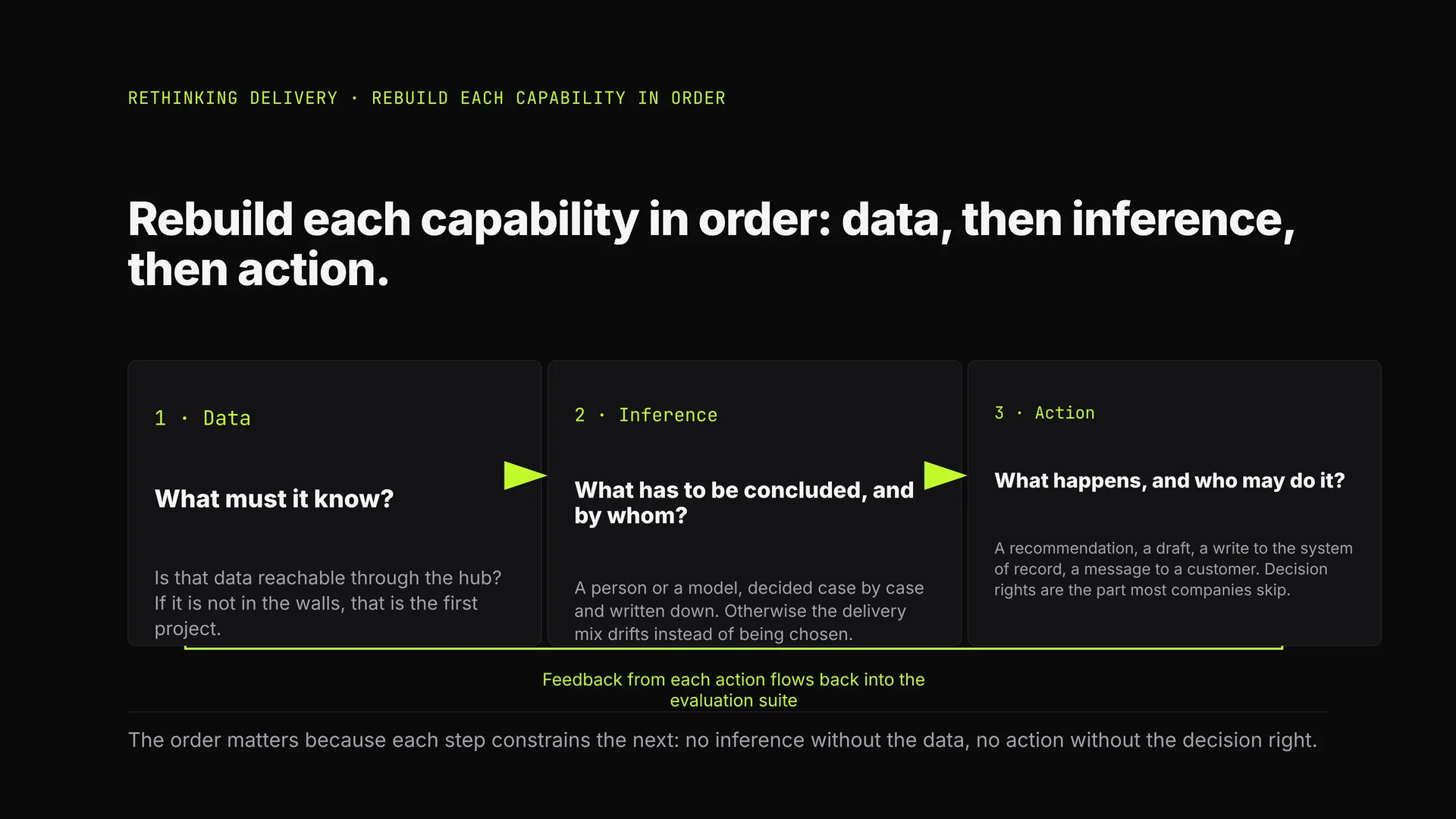
Once a capability is named, it is rebuilt in a fixed order, and the order matters because each step constrains the next.
- Data. What does this capability need to know, and is it reachable through the hub? For a pricing decision: the order history, the market feeds, the competitor set, the company’s own costs. If the data is not in the walls, that is the first project.
- Inference. What has to be concluded, and who concludes it, a person or a model? Normalizing a supplier’s financials is inference a model does well; deciding whether the supplier’s story is credible is inference a person still owns. Writing this down is what makes the delivery mix a decision rather than a drift.
- Action. What has to happen as a result, and who may do it? A recommendation to a line manager, a draft the analyst edits, a write to the system of record, a message to a customer. Decision rights are the part most companies skip. BCG finds 42% of companies planning to give agents decision authority by 2030 and 5% with the controls to do it.
Decision rights for agents
Agents earn decision rights one rung at a time: observe and report; recommend to a named person, with precision tracked; act with approval for defined decision types, with rollback and an audit trail; act within limits under documented decision rights and tested controls. Four controls sit under every rung: a named person who can see what the agent did, rollback that has been tested, an audit trail of every action, and a cost guardrail per agent. The feedback from each action flows back into the evaluation suite, which is how the capability improves rather than merely running.
Departments, roles and incentives
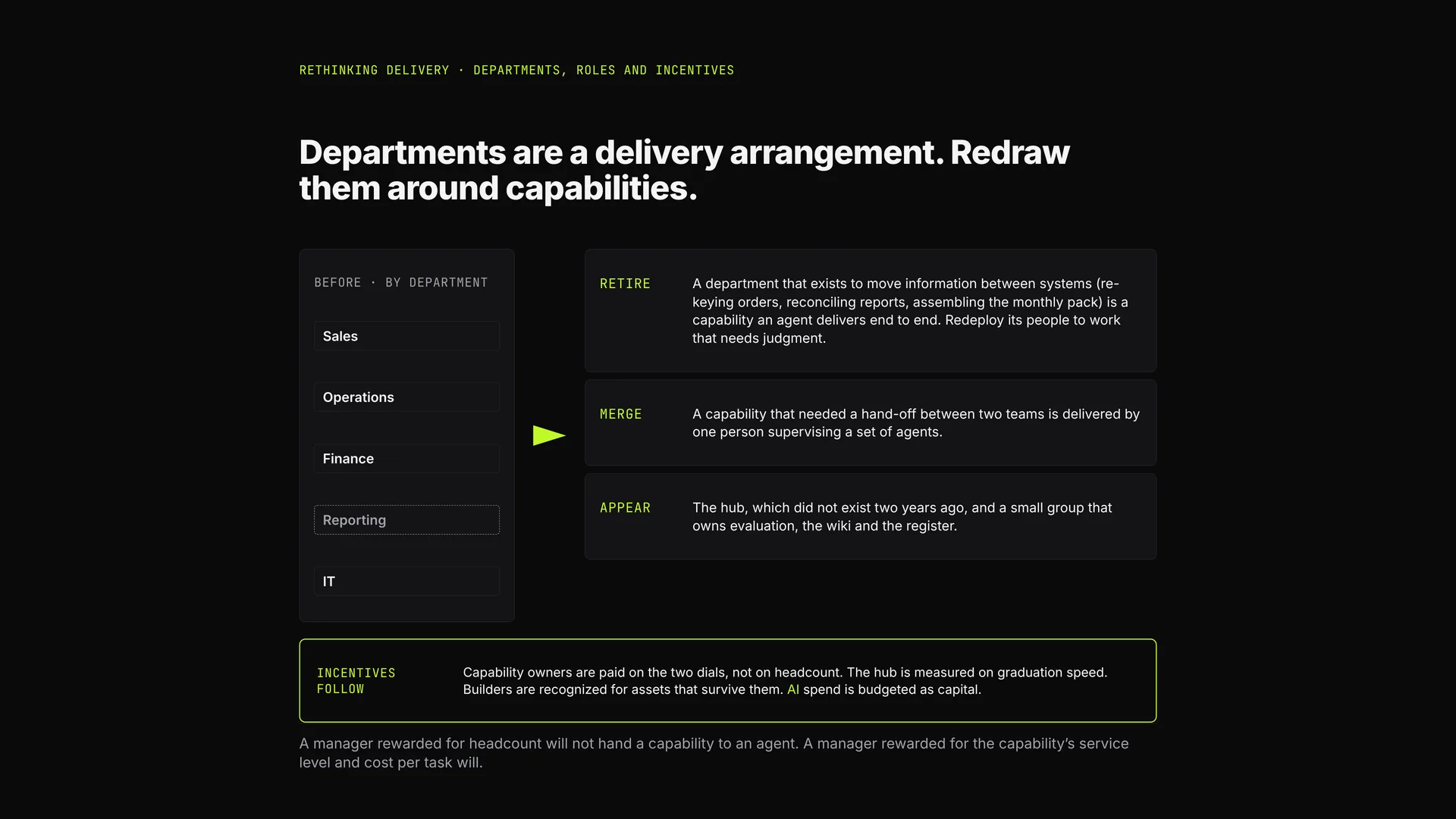
Departments are a delivery arrangement, not a capability, and once capabilities are the unit of design some departments stop making sense. A department that exists to move information between two systems (re-keying orders, reconciling reports, assembling the monthly pack) is a capability an agent can deliver end to end, and the honest response is to retire the department and redeploy its people to work that needs judgment. Other departments appear: the hub itself, which did not exist two years ago, and a small group that owns evaluation, the wiki and the register. Others merge, because a capability that used to need a hand-off between two teams can be delivered by one person supervising a set of agents.
Five roles carry the design, most of them part-time at a mid-sized company. The hub owns the road: connectors, identity, logging, the standard build and the register. Capability owners own one capability’s service level, delivery mix and benchmark, whichever departments its people sit in. Licensed builders build at the edge, tiered by what they may touch. Champions, one per department, are the first call for help and the ones who feed the wiki. A governance board acts as the utilities commission, meeting monthly to set tiers, assign decision rights and retire what is done.
Incentives have to move with the design or the design will not hold. A manager rewarded for headcount will not hand a capability to an agent; a manager rewarded for the capability’s service level and its cost per task will. So the variable pay of capability owners tracks the two dials, the hub is measured on how fast graduation runs and how little approval it takes to use the walls, and builders are recognized for assets that survive them rather than for heroics that do not. The budget moves the same way: AI spend is treated as capital invested in capabilities and reviewed like any other capital project, instead of a software line each department defends.
Measurement
One number tells a board whether the foundation is working, and it can be computed from figures the finance team already has.
Return on Intelligence
The measure of AI’s impact is the return the company earns on everything it pays to think, whether the thinking is done by people or by models.
Return on Intelligence = Operating income / (People cost + AI spend)
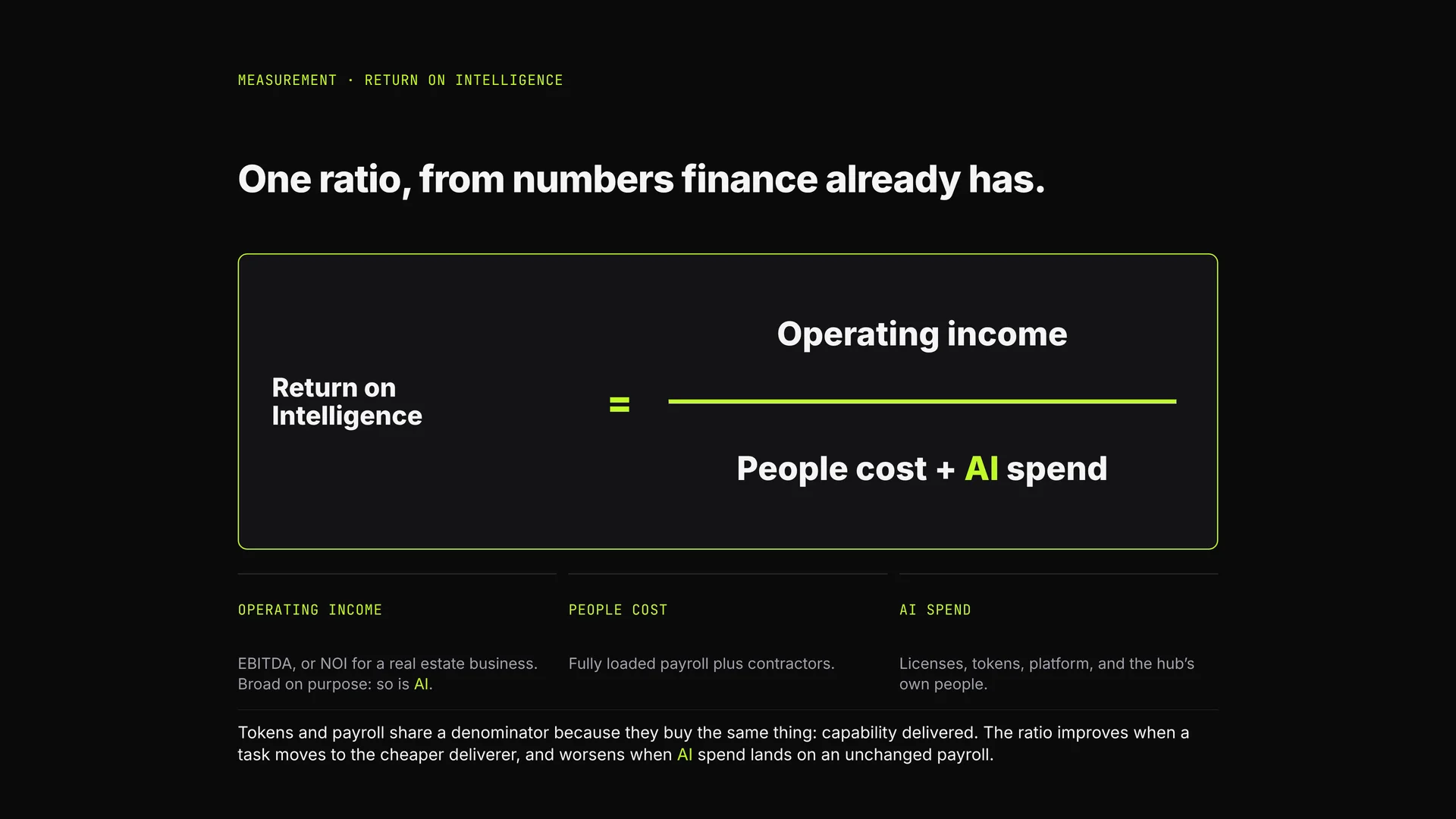
Operating income is EBITDA, or NOI for a real estate business. People cost is fully loaded payroll plus contractors. AI spend is licenses, tokens, platform and the hub’s own people. The two spends share a denominator on purpose: tokens are displacing people, and the ratio should get better when a task moves from one to the other at lower cost, and worse when a company adds AI spend on top of an unchanged payroll. Return on Intelligence is broad, but so is AI, and its breadth is what makes it calculable in an afternoon.
The number means little once. It means a great deal over time, read three ways.
- Level. This quarter’s ratio, one number for the board.
- Growth. The change against the same quarter last year. A good program shows this after a year.
- Acceleration. Whether the growth rate is itself rising. Exponential growth means the rate of increase is increasing, and acceleration is the only one of the three readings that distinguishes a foundation that compounds from a collection of tools that each paid off once.
Two adjustments keep it honest. Index the ratio to the market (a competitive set, a sector index) so that a good year for everyone does not get booked as AI. And expect a dip. AI spend lands two to four quarters before income moves or people cost falls, so the ratio falls before it rises. Economists call this the productivity J-curve, and it has accompanied every general-purpose technology. Name it before the first report so that the dip does not end the program.
Benchmarks are the companion measure for speed. Choose a fixed set of company tasks (a bid analysis, a credit review, the month close, a customer issue to resolution), time them twice a year, and report the cycle time and how often it halves. Moon shots are set as targets on this list. A company whose benchmark times halve on a schedule has evidence of acceleration before the financial ratio shows it.
Where to start
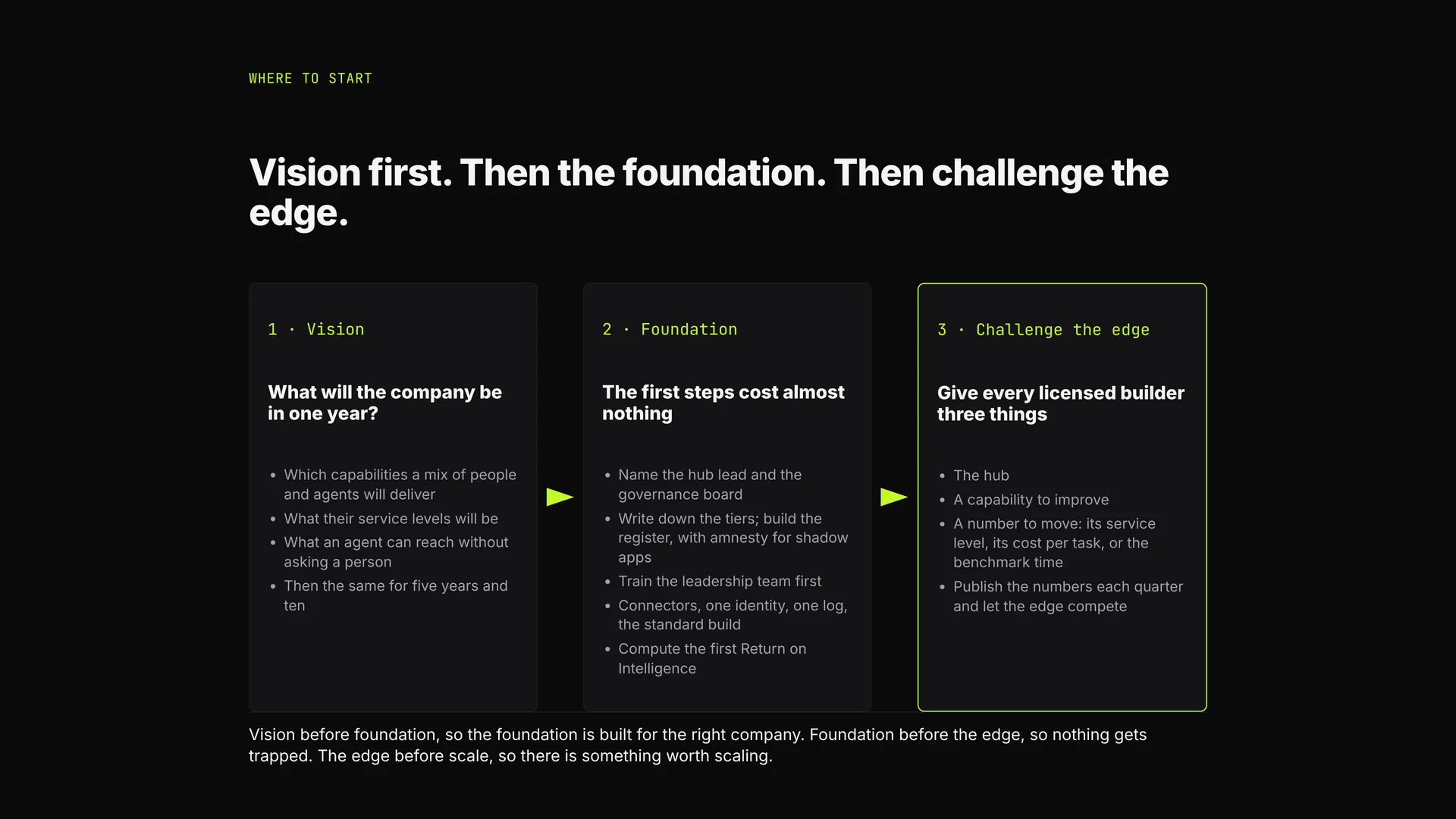
Start with a vision. Write down what the company will be in one year: which capabilities will be delivered by a mix of people and agents, what their service levels will be, and what an agent will be able to reach without asking a person. Then do the same for five years and ten. The one-year version drives the decisions, because it is close enough to fund and far enough away that the foundation has to exist before it arrives.
Set the foundation next, and the first steps cost almost nothing. Name the hub lead and the governance board. Write down the tiers. Build the register from what already exists, with an amnesty for every shadow app, because the goal is a complete list rather than a clean one. Train the leadership team first. Open the data through governed connectors, put identity and logging in one place, and stand up the standard build. Compute the first Return on Intelligence so there is a baseline to beat.
Then challenge the employees. Give every licensed builder the hub, a capability to improve and a number to move: the service level on that capability, its cost per task, or the benchmark time. Publish the numbers each quarter and let the edge compete to move them. The order matters. Vision before foundation, so the foundation is built for the right company. Foundation before the edge, so nothing gets trapped. The edge before scale, so there is something worth scaling. A company that holds that order ends up with a Return on Intelligence that rises at an increasing rate, which is the whole point.
Three questions settle whether a company has a foundation or a collection of tools. Which of our AI applications would survive its builder leaving next month? What data can an agent reach today without asking a person? What will we measure next quarter that we did not measure this one?
Notes
- McKinsey, The state of AI in 2026: On the road to ROI, August 2026: “Eighty percent of respondents report that AI has improved their individual productivity.” “Thirty-seven percent of respondents attribute at least some EBIT impact to AI use.” “A striking finding this year is the gap between individual gains and enterprise impact.” AI high performers “account for just 6 percent of survey respondents, unchanged from 2025,” and “nearly three-quarters of high performers report fundamentally redesigning workflows because of their AI use.”
- BCG, Applied AI Index 2026, September 2026, 1,330 executives: “Nearly half of companies are already creating real value from it,” while “many others are still struggling to translate investment into impact.” The 7.5% BCG calls future-built earn “2.3 times the total shareholder return, 2.4 times the revenue growth, and 2.8 times the EBITDA growth of laggards.” “AI spending has grown, from about 1.7% of revenue in late 2025 to 3.3% now,” and “more than 80% of AI spending now sits outside enterprise IT.” 42% expect to give agents autonomy by 2030; 5% have the full set of controls. “That gap is the defining challenge of the next two years.”
- PwC, 29th Global CEO Survey, January 2026, 4,454 CEOs: “Overall, 33% report gains in either cost or revenue, while 56% say they have seen no significant financial benefit to date.” “Only one-in-eight (12%) CEOs say AI has delivered both cost and revenue benefits.”
- IBM Institute for Business Value, CEO Study, May 2025, 2,000 CEOs: “Only 25% of AI initiatives have delivered expected ROI over the last few years” and “only 16% have scaled enterprise wide.” Half say the pace of investment has left them with “disconnected, piecemeal technology.”
- MIT NANDA, The GenAI Divide: State of AI in Business 2025, July 2025: against $30 to $40 billion of enterprise investment, “95% of organizations are getting zero return.” The cause is “the learning gap, tools that don’t learn, integrate poorly, or match workflows.” “Only 5% of custom enterprise AI tools reach production,” while “workers from over 90% of the companies we surveyed reported regular use of personal AI tools for work tasks.”
- Gartner, June 2025, predicts “over 40% of agentic AI projects will be canceled by end of 2027,” citing rising costs, unclear business value and inadequate risk controls. Its February 2025 survey found that 60% of AI projects unsupported by AI-ready data will be abandoned, and that 63% of organizations lack the data practices.
- METR, Measuring AI Ability to Complete Long Tasks, March 2025, and its later updates: the length of task a frontier model can complete on its own has doubled roughly every seven months since 2019, with the 2024 to 2025 trend closer to four.
- Federal Reserve, SR 11-7: Guidance on Model Risk Management, April 2011: the supervisory guidance that has required banks to inventory, validate and govern every model in use.