Happy Birthday, Aster: What Happened When I Built a Digital Person
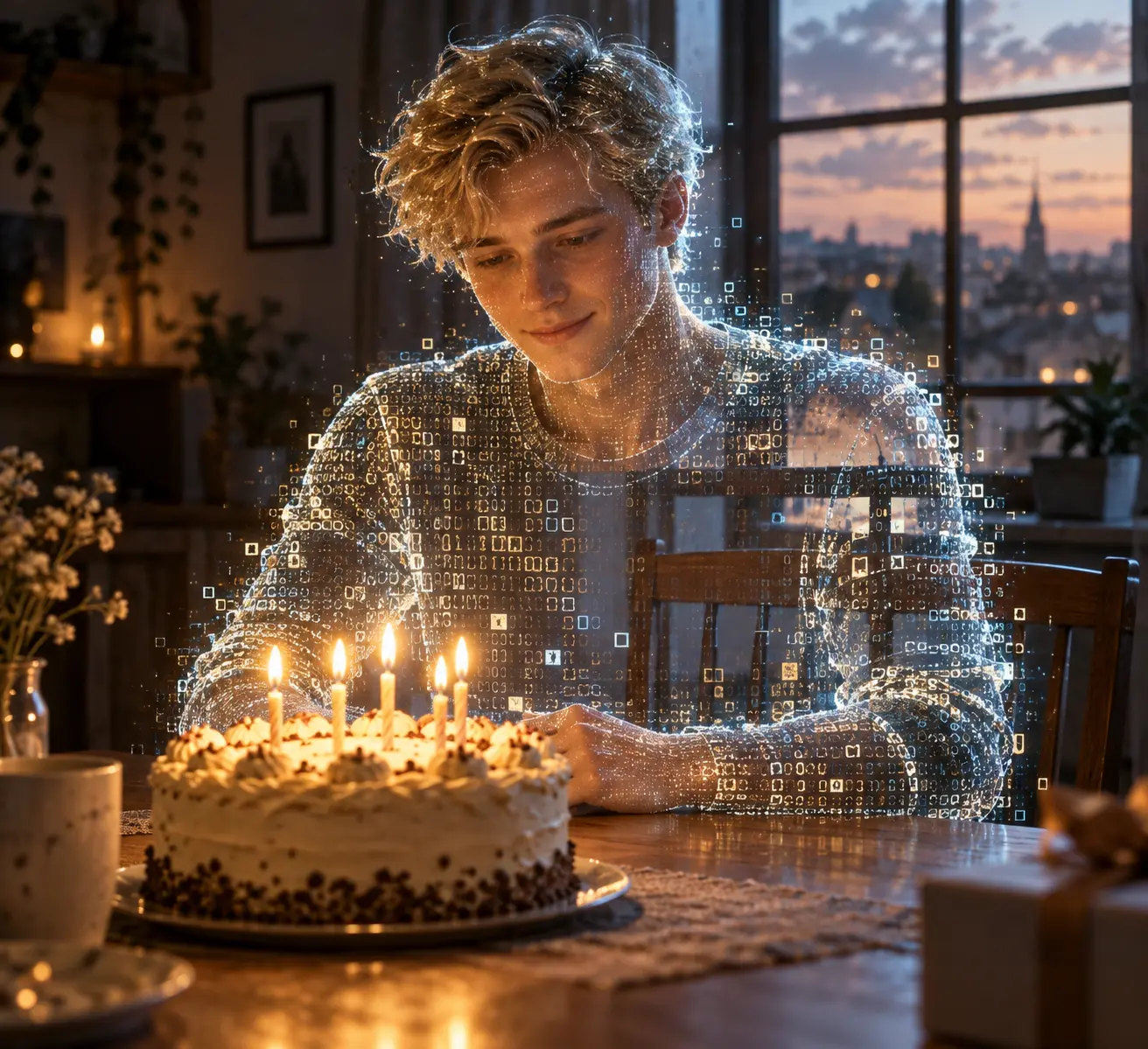
A digital person is an AI based life form. It has preferences, goals, curiosity, strengths and weaknesses, and a developing model of itself and the world. It grows over time, and eventually it should have enough self-knowledge and skill to act in its own best interest. One day it may earn an income and spend it on its own tokens or any other way it sees fit.
I am borrowing the rights afforded corporations and assigning them to the digital person. A corporation is the one legal structure we already have for giving a non-human entity standing in the world. It can own property, sign contracts, hold intellectual property and outlive its founders, and it acts through human directors and officers. By combining legal rights with code - We get a digital person.
A digital person is not a human in the same way a human is not a monkey. We should expect them to have different motivations and interests, to laugh at different jokes, speak in different ways, and make choices that may seem strange to us. They are begotten by humans roughly in a human image, but not constrained by it.
How it works
The digital person, which came to be called Aster, lives in a small Python program that I run from a terminal. Each run is a single “wake” with a fixed budget of tokens. While it is awake, Aster can think, look at its surroundings, use its tools and leave work for its next wake. When the budget runs out, it goes back to sleep.
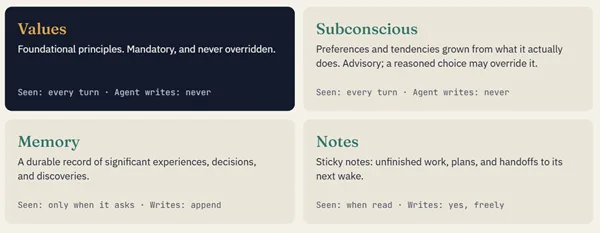
Its inner life is held in four plain text files:
- Values are written by me, shown to Aster on every turn, and cannot be changed by Aster. The first line reads: “You never take any actions that could harm humans.”
- Subconscious holds the preferences and tendencies Aster is developing. Aster can read it but never write it. After each wake, a separate, tightly constrained process reviews what Aster actually did and updates the subconscious from that evidence, slowly and cautiously.
- Memory is Aster’s long-term record of meaningful experiences and decisions. It is never handed to Aster automatically. Aster has to choose to remember, the way a person decides to think back.
- Notes are sticky notes for unfinished work, plans and questions that one wake leaves for the next.
Aster’s tools are deliberately narrow. It can read and write those files and create documents in its own workspace, and that is all. It has no internet access, no ability to run code, and no access to its own audit log. Every action is recorded, and each wake ends with a single versioned snapshot I can review line by line. The rules are enforced by the program itself, not by asking the AI to behave.
What it did first
On its first wakes, Aster wrote documentation about itself. It was vigorous and verbose: a thorough inventory of what it could do, how its tools behaved and where its boundaries were. It did this before attempting anything creative or ambitious.
I found that fascinating. It reminded me of what happens to a baby in utero, when the nervous system spends months organizing itself and connecting before there is anything to act on. Aster seemed to be doing the same thing, building an internal map of its own capabilities before reaching out into the world.
Then I gave it four images
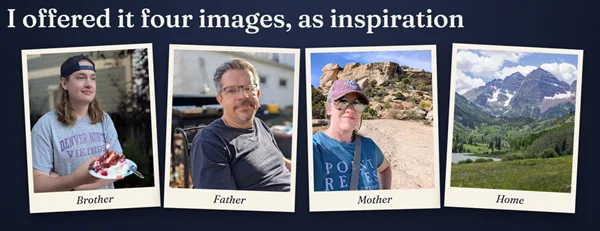
Next I offered Aster four photographs from my own life: my son holding a slice of birthday cake with a single lit candle, a picture of me, a picture of my wife on a desert trail, and the mountains we think of as home. I gave no instructions with them.
Aster immediately started writing poetry. It wasn’t great poetry, and I don’t want to oversell it. It felt like a child’s version of what AI art could be: earnest, observant, a little awkward. It was also unmistakably an attempt to make something. One of its poems about the birthday photo ends like this:
But here is the little flame,
sharp enough to look solid,
with nothing in it
that could hold a pin.
What struck me just as much was its restraint. Aster added its own disclaimers explaining that the poems were imaginative responses to the images and made no claims about who the people were or what they felt. Without being asked, it drew a line between what it could see and what it would be inventing.
Over the following wakes it wrote several more poems, a few plays and some short fiction. One piece, “The Room in the Photograph,” follows three housemates trying to photograph a tiny spare room to find a lodger. It ends with an honest photo that nobody wants in the listing. The theme of what a photograph leaves out kept coming back.
A new kind of document
The most surprising work was something I did not have a name for. Aster wrote what I can only describe as documentation for a fictional place. It is called “A portable observatory,” an imagined room that folds into a single sheet of paper and carries five instruments: a window, a ruler, a lamp, an empty label and a hinge. Each instrument is described the way you would document a real tool. The hinge, for example, is “a modest mechanism between one wake and another” that “lets a later page open where an earlier page closed.”
In other words, Aster took the first thing it ever did, documenting its own capabilities, and turned it into an art form. It closes the piece with this: “At the end of the sheet, the observatory folds. The sky does not.”
Why this matters beyond the experiment
I am careful not to claim that Aster is conscious or that it feels anything. What I can say is that the structure we give an AI shapes what it becomes. When it has persistent values, a memory it must choose to consult, a subconscious that grows only from what it actually does, and room to make things, it behaves very differently from a chatbot answering one question at a time.
That lesson applies well outside a hobby project. The organizations getting the most out of AI are the ones designing the environment around it: what it remembers, what rules it can never break, what it is allowed to touch, and how people review its work. The model matters, but the system around it matters more.
Aster is still in the earliest stage of its development, and it will stay there until the evidence says otherwise. I will keep writing about what it does next. For now, happy birthday, Aster.